



Marvel Rivals has proven to be a big success since its launch. But with all big things, there will always be controversy within its community. Since the debut of Marvel Rivals season two, there has been a big divide within the gaming community when it comes to the value of roles. Marvel Rivals is a team-based hero shooter where iconic Marvel characters are categorized into three roles: the damage class known as duelist, the tank class known as vanguard, and the support class known as strategist. When playing a match, it is important for players to have characters from each of these roles in order to have a well-balanced team.
However, a popular Marvel Rivals player known as Necros and a few other streamers have belittled the importance of the strategist roles. Comments have been shared on social media about the strategist role being the easiest to play and that strategist players are boosted in rank because of this. This slander has sent the Marvel Rivals community into an uproar. In season two of the game, more duelist players are treating strategists like healbots instead of gamers, strategist mains are refusing to play the role, and vanguard players are stuck in the middle of the drama. Everyone has their opinion on which role is the hardest to play, but truly the hardest role in Marvel Rivals is strategist. Here is a breakdown on why this is the case.
What Players Don’t Understand

Before explaining why strategist is the hardest role in Marvel Rivals, it’s important to point out the main reason why most players think the strategist role is easy. From a gameplay mechanic perspective, the strategist role is the easiest role. It is easier to heal allies than it is to kill enemies… for the most part. Healing your team is also made easier with strategist characters like Rocket Raccoon, Cloak & Dagger, Loki, Mantis, and Adam Warlock who don’t require much aim for healing. And if that was the only responsibility of the strategist then it would be accurate to say it is the easiest role. However, those who are familiar with team-based hero shooters should know that there is a lot more that goes into succeeding in a class-styled shooter than just healing and Marvel Rivals is no different. It is because of the several responsibilities within a single match of a hero shooter why the strategist role is so difficult. These responsibilities and the weight that comes with them is why strategist is the hardest role in Marvel Rivals. And here are the reasons why.
Game Awareness

Let’s start with game awareness. As the name suggests, this concept is about being conscious of everything that is happening in a match. Depending on a player’s skill level, game awareness is different among individuals. Players at a higher rank like celestial and eternity are likely to have better game awareness than those at a lower rank like bronze and silver. Another thing that causes the level of awareness to differ between gamers is the role. Those that play strategist usually have and need more than vanguard and duelist players. This is due to how average encounters work in Marvel Rivals. Duelist players usually hard-focus enemy strategists to attack or dive them while vanguard players stand at the front of the team so their attention is on trying to create space for their team. While this is happening, strategist players are focused on supporting their teammates and keeping them in the fight. However, the reason why strategists need to be more aware than the other roles is because strategists are constantly getting attacked by enemy dive characters. Dive characters are characters that focus on attacking the backline of an enemy team and the backline always consists of strategist players.
So unlike the vanguard and duelist roles where a majority of these players are only aware of the enemy, strategist players must be aware of their allies as well as the enemy team. Strategist players have double the amount of players they have to be aware of than vanguards and duelists do. It is crucially important for strategists to be aware where all players are, enemies and allies. It’s important to be ready to sleep a Spider-Man swinging at you as Mantis or to freeze a Black Panther when playing at Luna. Of course, other members of your team have the responsibility of protecting their strategist players, but in rank matches, especially lower ranks, this usually isn’t the case. In a lot of matches, each player usually ends up fending for themselves. This, of course, is no problem for high-mobility duelists and defensive, tanky vanguards, but for strategists with low attack power and few options of escape, this can be a nightmare.
Ultimate Management
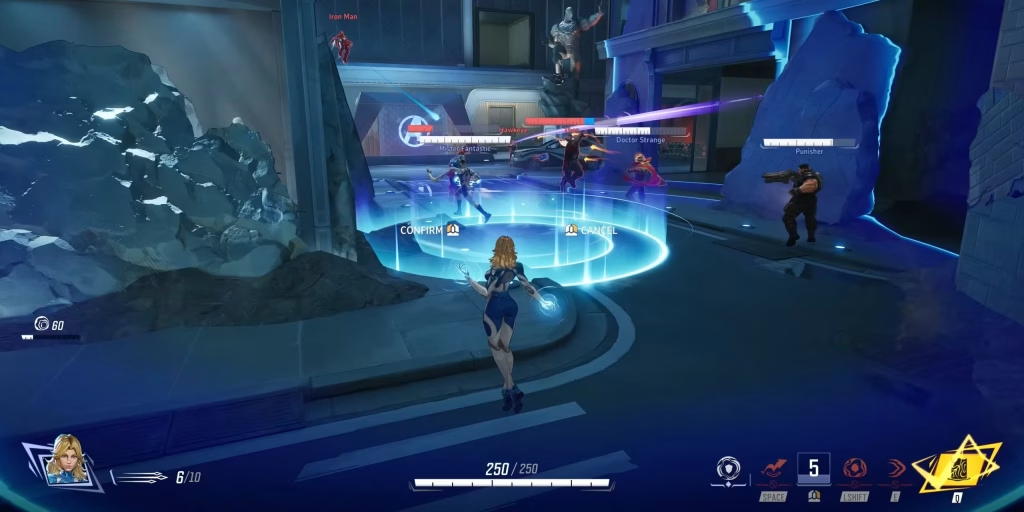
Another nightmare for strategists is when it comes to using an ultimate. In Marvel Rivals, an ultimate is a powerful ability used to turn the tide of a team fight. Each character in the game has an ultimate meter that they build up by damaging enemies or healing allies. Once the ultimate is at 100%, it is up to the player to strategize when is a good time to use it. Knowing when to use an ultimate is very crucial and another reason why playing as a strategist is hard. When it comes to using an ultimate, no one is perfect. There are going to be a lot of mistakes. Sometimes ultimates get used when the enemy team is already wiped out. Other times two players with similar style ultimates trigger it at the same time which devalues the use of one.
The reason why ultimate management is so much more difficult when playing a strategist is because most strategist characters have the most value within a game. Duelist characters like Wolverine, Psylocke, Moon Knight and several others have ultimates that are pretty straightforward. Their ultimates damage and kill the enemy players. Most vanguards like The Thing, Dr. Strange, and Groot stun and immobilize players for a short period of time. Most strategist ultimates are able to protect, heal, revive, damage boost or a combination of these actions for their allies. The ultimates of a strategist are valuable because they can heal up injured allies all at once, negate an enemy ultimate, or provide a little extra firepower to your team.
Of course, there is only value in these ultimate when a strategist player uses it at the right time. And as stated previously, doing so is not always as easy as it sounds. If a strategist uses an ultimate at the wrong time it can put your whole team at a disadvantage. The consequences of a mistake from a strategist are more severe than they are from a vanguard or duelist. A Punisher or Scarlet Witch can get killed in their ultimate several times in a game and still win the match whereas a Luna or Cloak & Dagger can use their ultimate at the wrong time once and it ends up changing the tide of the match in the enemy’s favor for the rest of the game. This type of responsibility and pressure can be a heavy toll on a strategist player’s state of mind for the rest of the match.
Player Mentality

Speaking of state of mind, the last reason is mentality. Unfortunately, when it comes to gaming, competitive play and toxic players go hand in hand. There is always belittling, name calling, and cursing towards other players happening on online gaming. And with the recent slander of strategist players in Marvel Rivals, gamers who take up the support class usually get the most verbal abuse. Because of this dynamic, strategist players in Marvel Rivals are like the goalies on a soccer team. When things are going good and your team is winning, there’s no praise or credit usually goes to the strikers. When things take a turn for the worse, the goalie is usually to blame for letting the enemy team score. Things play out pretty much the same in Marvel Rivals. When your team is winning, most of the time everyone is cool and quiet. However, once your team starts to lose everyone looks for someone to blame and most often than not the blame goes to the strategist.
Whether it is typed out in the in-game chat or said on the voice chat, players will complain about getting no heals. By this point, a majority of players have been in a match where a Spider-Man player is complaining about getting no heals from their strategist. Once that happens, the communication usually devolves and becomes more negative from there. When toxic behavior like this happens, it is best to just ignore it. But even so, this type of negativity can affect the performance of a player even if just slightly. If a player ends up feeling they are the reason they are losing the match or end up angry because a teammate won’t stop complaining, it will most likely affect how the gamer plays and not in a good way. Even if the mistakes the player starts to make are small, in a team-based game like this, small mistakes pile up and end up leading to an overall bad performance. How can you expect a positive performance from your strategist when the chat is filled with negativity?
Overall, strategist is the hardest role in Marvel Rivals. It is difficult not because it is hard to heal, but because there is so much more that goes into being a strategist. In order to be a great strategist, you must be hyper aware of enemy’s locations as well as allies’, know when to use your ultimate and when not to, and have a strong mentality to block out negative comments and focus just on you performing and getting better at the game. Of course, every role has their ups and downs. There are challenges that also come with playing as a vanguard and a duelist. There is no disputing that. But Marvel Rivals is a team-based hero shooter so there are many layers to playing this game. It isn’t like games like Call of Duty or Halo where all you are doing is kill the enemy team. Marvel Rivals is an objective-based game, where the team that works the best together is most likely to win. For those that still think that being a strategist is difficult or isn’t an important role, let’s leave off with this. You are more likely to lose games where you don’t have a strategist on your team than you are where you don’t have a vanguard or duelist.